• 2010
  • 2009

New weekend for SAC 2010 SSB!

Due to a very huge collision with CQ WW RTTY DX Contest we have decided to move the SSB part of SAC to the second full weekend of October.

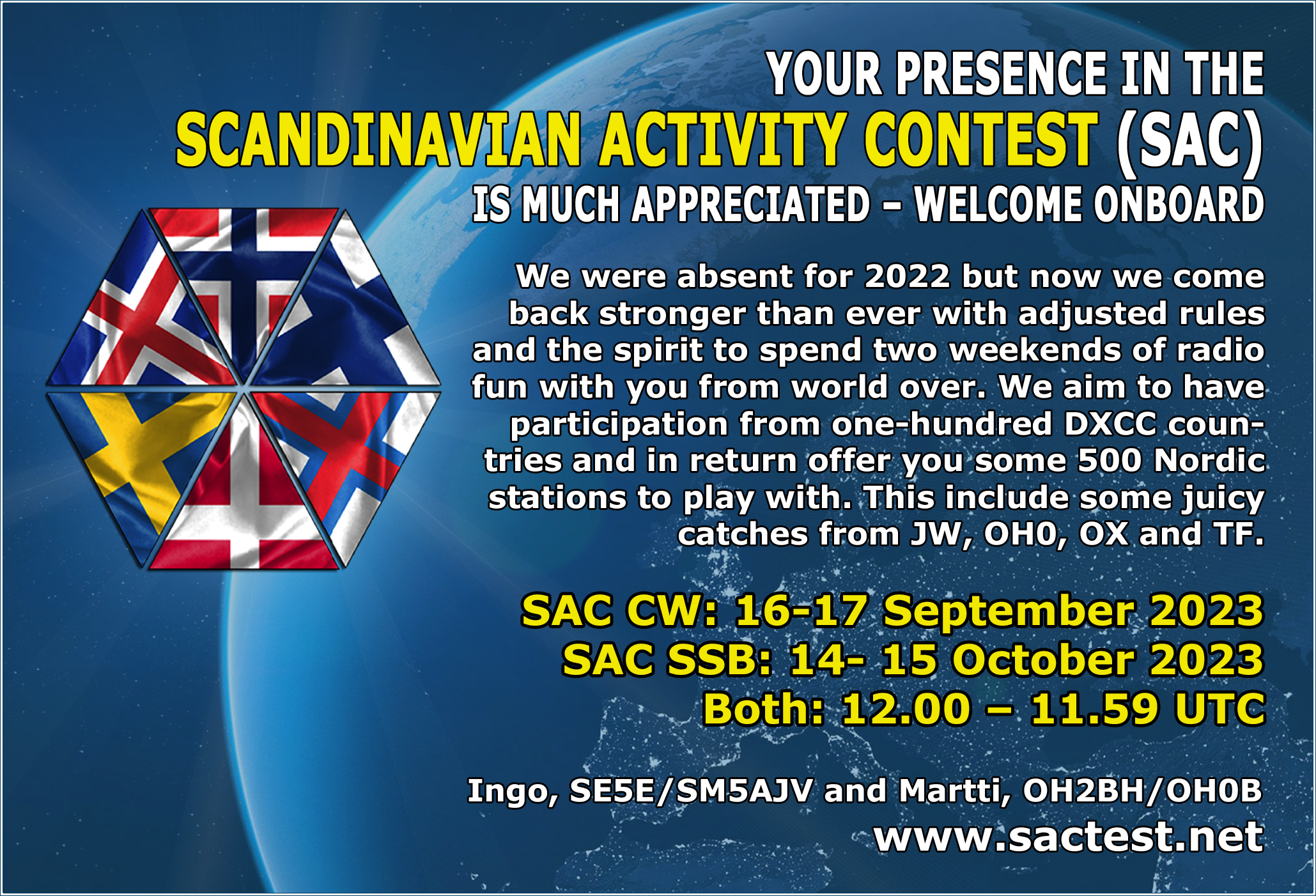
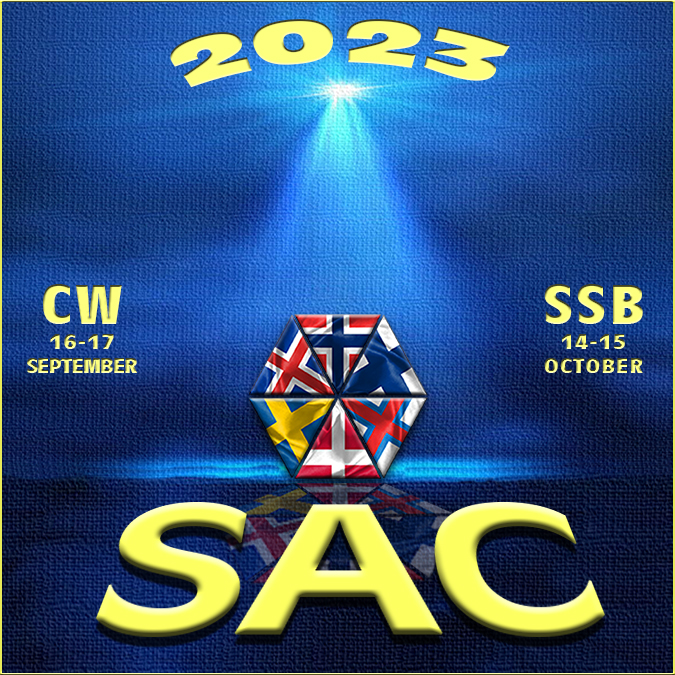
The dates and times for The Scandinavian Activity Contests for 2010 are:

CW: 2010 September 18, 1200 UTC to 2010 September 19, 1200 UTC
SSB: 2010 October 9, 1200 UTC to 2010 October 10, 1200 UTC

SAC Contest Committee - 2010-Jun-01

SAC 2010 - Announced operations

Ingemar, SM5AJV has done a very nice list for "Announced operations" for SAC 2010 on his site.

Please go to qrq.se/sac/ and announce yourself. You can also see which other calls to look for in SAC.

SM3CER - 2010-Aug-11

Final results SAC 2009

The final results for SAC 2009 can be found at http://www.sk3bg.se/contest/res/r09saccn.htm

SM3CER - 2010-Aug-11

SAC 2010 - Announced operations

Ingemar, SM5AJV has done a very nice list for "Announced operations" for SAC 2010 on his site.

Please go to qrq.se/sac/ and announce yourself. You can also see which other calls to look for in SAC.

SM3CER - 2010-Aug-11

Final results SAC 2009

The final results for SAC 2009 can be found at http://www.sk3bg.se/contest/res/r09saccn.htm

SM3CER - 2010-Aug-11

Band Plan Recommendations for 7 MHz

The band plan for the 7 MHz band has been changed and we recommend the following frequency segments for the Scandinavian Activity Contest, according to the IARU Region 1 Band Plan. For details please refer to the IARU R1 HF Band Plan at http://www.iaru-r1.org

CW

7000 - 7025 kHz Contest preferred.

Note: The whole 7000-7200 kHz band can be used for CW, but take care and try to NOT interfere with other services.

SSB

7060 - 7100 kHz Contest preferred.
7130 - 7200 kHz Contest preferred.

Note 1: 7050-7200 kHz may be used on SSB, but take care and try to NOT interfere with other services.

Note 2: You may still want to work split on SSB between Scandinavia and Region 2 stations, since the Region 2 Band Plan upper frequency limit is 7300 kHz.

SM3CER - 2009-Sep-18

Results CW
Results SSB

Rules for participants from Scandinavia

CW: 2010 September 18, 1200 UTC to 2010 September 19, 1200 UTC
SSB: 2010 October 9, 1200 UTC to 2010 October 10, 1200 UTC

1. Aim of the contest

The aims of the contest are to promote amateur radio activity within Scandinavia as well as to encourage amateur radio communications between Scandinavian and non-Scandinavian amateur radio stations. Scandinavian stations will try to work as many non-Scandinavian stations as possible.

Scandinavian stations are defined by prefixes as follows:

Svalbard and Bear Island JW
Jan Mayen JX
Norway LA - LB - LG - LJ - LN
Finland OF - OG - OH - OI
Aland Islands OFØ - OGØ - OHØ
Market Reef OJØ
Greenland OX - XP
Faroe Islands OW - OY
Denmark 5P - 5Q - OU - OV - OZ
Sweden 7S - 8S - SA - SB - SC SD - SE - SF - SG - SH SI - SJ - SK - SL - SM
Iceland TF

All other legal prefixes according to the ITU definition of Scandinavian prefixes are good for the contest and multipliers as well.

2. Eligible entrants

Radio amateurs and SWL’s all over the world are invited to participate.

3. Periods

CW: 3rd full weekend of September each year.
SSB: 2nd full weekend of October each year.

Starts 1200 UTC Saturday and ends 1200 UTC Sunday.

4. Sections

4.a) Single Op./Single TX

* Multi Band - High Power [SINGLE-OP ALL HIGH]
* Multi Band - Low Power (output 100 W or less) [SINGLE-OP ALL LOW]
* Multi Band - QRP (output 5 W or less) [SINGLE-OP ALL QRP]
* Single Band [SINGLE-OP 80M] [SINGLE-OP 40M] [SINGLE-OP 20M] [SINGLE-OP 15M] [SINGLE-OP 10M]

Single operator means that one person performs all operating, logging and spotting functions without any assistance from other person(s). The use of DX-Cluster is not allowed. Asking and begging stations to announce own call in DX-Cluster is NOT allowed.

4.b) Multi Op./Single TX/Multi Band [MULTI-ONE]

Only one signal may be transmitted on any band at any time (running station). When operation has started on one band, the station must remain on that band for at least 10 minutes. The 10 minutes-period starts with the first QSO worked on that band.

Exception: It is allowed to work a station on another band if it is a new multiplier (multiplier station). The multiplier station is allowed to be on the air at the same time as the running station. The multiplier station must also stay on the "multiplier band" at least 10 minutes. This rule is similar to the CQ WW DX Contest.

Use of multiplier spotting assistance from other persons than the station-operators is not allowed. However, DX-Clusters may be used by Multi Operator stations.

Asking and begging stations to announce own call in DX-Cluster is NOT allowed.

4.c) Multi Op./Multi TX/Multi Band [MULTI-MULTI]

The use of DX-Cluster is allowed. Asking and begging stations to announce own call in DX-Cluster is NOT allowed. There are no restrictions on the number of transmitters. Only one signal per band is allowed at any time. All stations must locate within a circle with a diameter of maximum 500 meters.

4.d) SWL - Single Operator/Multi Band [SWL]

Only non-Scandinavian stations may be logged for points. Scoring as for transmitting sections.

5. Bands

3,5 - 7 - 14 - 21 - 28 MHz bands may be used according to IARU HF Band Plans.

Operating Frequency suggestions Low Band SSB: 7040-7090, 3600-3650 and 3700-3790 kHz. (Avoid operating on 7090-7100 and 3790-3800 kHz).

(NB: 3560-3600, 3650-3700, 14060-14125 and 14300-14350 kHz to be kept free from contest traffic).

6. Contest exchanges

The contest exchange consists of RS(T) plus serial number starting with 001 (e.g. 59(9)001). (QSO’s after 999 are numbered 1000, 1001 etc). The same station may be worked once on each band. Cross-mode and/or cross-band QSO’s are not allowed. The minimum content of a valid contest QSO is correct callsign and correct contest exchanges.

7. Scoring

Two-way QSO with sent and received exchange counts for QSO-points.

* EUROPEAN stations give two (2) points per every complete contact.
* NON-EUROPEAN contacts give three (3) points per QSO.

8. Multipliers

Worked DXCC countries are valid for multiplier on each band.

9. Final score

To calculate the final score, multiply the sum of QSO-points on all bands with the sum of multipliers worked on all bands.

10. Logs

Signed original logs (or copies of original logs) must be submitted separately for CW and SSB. Single operator and multi-single logs must be submitted in chronological order. Multi-operator multi-transmitter stations use separate serial numbers for each band.

Logs to be filled in the following order:

Date and time UTC, Band, Station worked, Exchange sent, Exchange received, Multipliers and Points.

SWL-log must contain:

Date and time UTC, Band, Station heard, Message sent by Station heard, SWL’s own report, Station worked by Station heard, Multipliers and Points.

SUMMARY SHEET

All entries must be followed by a summary sheet showing station callsign, contest category, name of operator(s) and address. Indicate number of QSO’s per band less duplicates, number of duplicates per band, multipliers per band, QSO-points per band and final score. A Single Op. log not showing the power category will be counted as High Power.

MULTIPLIER SHEET

All entrants must submit a multiplier check list for each band with more than 200 QSO’s.

DUPLICATE CHECK LIST

Possible duplicate QSO’s must be shown in the log and counted for zero (0) points. Each entrant shall submit a duplicate check list for each band with more than 200 QSO’s. Duplicate check list to contain worked stations listed e.g. by DXCC-countries.

ELECTRONIC LOG

Electronic submission of logs is encouraged - and in fact required - for all top scoring entrants and all who use a computer to log or prepare the logs. The CABRILLO format is preferred. Please ensure that you fill out all of the header information. If you submit a CABRILLO log, no additional summary sheet is required. (However, if you like to compare your claimed scores with others before the final results are published, you are encouraged to enclose your summary sheet as well).

CLICK HERE for more information on the CABRILLO format.

If you cannot submit a CABRILLO log, you may submit the ASCII output from most of the popular logging programs such as LAØFX, NA, OH2GI, SD, TR and Writelog. If the log is not in CABRILLO format, a separate summary sheet is required. Please name your files with yourcall and the file type.

Example: 7S3A submits a CABRILLO file. It should be named 7S3A.LOG. If 7S3A chose to submit a non CABRILLO file such as TR’s .dat file, he should name the log file 7S3A.DAT and the summary file should be 7S3A.SUM.

Logs sent on disk should be on 3.5", 1.44 Mb disks.

Logs submitted via e-mail should in the Subject: line include mode (CW or SSB), your callsign and the category you are entering, e.g., SOMBHP, SOMBLP, MOST, etc.

All logs received via e-mail will be confirmed via e-mail.

Basic rules: Only one QSO on each line. Each line must contain following information: Date and Time (full) UTC, Band, Mode, Station worked, Sent (full) exchange, Received (full) exchange, Multiplier (if applicable) and Points (dupes to be marked with (0) zero).

Computerized logs must be checked for typing accuracy. Please leave all your QSO’s in the log, dupes included. The log checking software will find the dupes and mark them with zero points.

If you send log on disc, paper log is not mandatory. Summary sheet must always be on paper (not when using e-mail). Disc must be clearly labelled with call, contest name, class and date of the contest. CW and SSB portion can be on same disc. Please use file-names like: OH9A.DAT or OH9A.CW or OH9A.SSB and OH9A.SUM.

11. Declaration

With her/his signature on the summary sheet, the participant declares that all the rules are observed and that the station was operated in accordance with the rules and regulations for amateur radio stations in the country of the participant.

12. Address for logs

The arrangement of the contest alternates between SRAL, SSA, NRRL and EDR in that order. For correct address, see the heading. Upload 2010 CW and SSB logs on: http://www.sactest.net/

13. Closing date for logs

Cabrillo logs shall be uploaded not later than October 19 2010 for CW logs and November 9 2010 for SSB logs.

14. Awards

TRANSMITTING SECTION: The top scoring High Power and Low Power station in each country, in each category, both CW and SSB, will receive a Contest Award, provided a reasonable score is made. Scandinavian winner stations may also receive a Contest Plaque on High-power and Low-power multi band categories.

QRP operators will be listed in one common list for all Scandinavians.

SWL: The top scoring station in Scandinavia will receive an award.

ALL SECTIONS: Depending on the number of participants, the Contest Committee may consider additional awards.

15. Dispute

Violation of Amateur Radio Regulations in the country of the contestant or of the rules for this contest, unsportsmanlike conduct and the taking of credit for unverifiable QSO’s or multipliers may lead to disqualification.

Each unmarked duplicate QSO found by the Contest Committee will result in a penalty of five (5) QSO’s of same value as the duplicate. A log showing more than one (1) percent unmarked duplicate QSO’s will be disqualified unconditionally.

The decisions by the Contest Committee are final and definite.

Right to changes in this rules are reserved.

The 53rd SAC in 2011 will be arranged by SRAL - Finland

Source: Peter Vestergaard, OZ5WQ - EDR Contest Manager HF

Arranging Societies

CW: 2010 18-19 Sep, EDR Denmark
SSB: 2010 9-10 Oct, EDR Denmark

CW: 2011 17-18 Sep, SRAL Finland
SSB: 2011 8-9 Oct, SRAL Finland

CW: 2012 15-16 Sep, SSA Sweden
SSB: 2012 13-14 Oct, SSA Sweden

CW: 2013 21-22 Sep, NRRL Norway
SSB: 2013 12-13 Oct, NRRL Norway

CW: 2014 20-21 Sep, EDR Denmark
SSB: 2014 11-12 Oct, EDR Denmark

CW: 2015 19-20 Sep, SRAL Finland
SSB: 2015 10-11 Oct, SRAL Finland

CW: 2016 17-18 Sep, SSA Sweden
SSB: 2016 8-9 Oct, SSA Sweden

CW: 2017 16-17 Sep, NRRL Norway
SSB: 2017 14-15 Oct, NRRL Norway

CW: 2018 15-16 Sep, EDR Denmark
SSB: 2018 13-14 Sep, EDR Denmark

CW: 2019 21-22 Sep, SRAL Finland
SSB: 2019 12-13 Oct, SRAL Finland

Rules for participants from outside of Scandinavia

CW: 2010 September 18, 1200 UTC to 2010 September 19, 1200 UTC
SSB: 2010 October 9, 1200 UTC to 2010 October 10, 1200 UTC

1. Aim of the contest

The aims of the contest are to promote amateur radio activity within Scandinavia as well as to encourage amateur radio communications between Scandinavian and non-Scandinavian amateur radio stations. Scandinavian stations will try to work as many non-Scandinavian stations as possible.

Scandinavian stations are defined by prefixes as follows:

Svalbard and Bear Island JW
Jan Mayen JX
Norway LA - LB - LG - LJ - LN
Finland OF - OG - OH - OI
Aland Islands OFØ - OGØ - OHØ
Market Reef OJØ
Greenland OX - XP
Faroe Islands OW - OY
Denmark 5P - 5Q - OU - OV - OZ
Sweden 7S - 8S - SA - SB - SC SD - SE - SF - SG - SH SI - SJ - SK - SL - SM
Iceland TF

All other legal prefixes according to the ITU definition of Scandinavian prefixes are good for the contest and multipliers as well.

2. Eligible entrants

Radio amateurs and SWL’s all over the world are invited to participate.

3. Periods

CW: 3rd full weekend of September each year.
SSB: 2nd full weekend of October each year.

Starts 1200 UTC Saturday and ends 1200 UTC Sunday.

4. Sections

4.a) Single Op./Single TX

* Multi Band - High Power [SINGLE-OP ALL HIGH]
* Multi Band - Low Power (output 100 W or less) [SINGLE-OP ALL LOW]
* Multi Band - QRP (output 5 W or less) [SINGLE-OP ALL QRP]

Single operator means that one person performs all operating, logging and spotting functions without any assistance from other person(s). The use of DX-Cluster is not allowed. Asking and begging stations to announce own call in DX-Cluster is NOT allowed.

4.b) Multi Op./Single TX/Multi Band [MULTI-ONE]

Only one signal may be transmitted on any band at any time (running station). When operation has started on one band, the station must remain on that band for at least 10 minutes. The 10 minutes-period starts with the first QSO worked on that band.

Exception: It is allowed to work a station on another band if it is a new multiplier (multiplier station). The multiplier station is allowed to be on the air at the same time as the running station. The multiplier station must also stay on the "multiplier band" at least 10 minutes. This rule is similar to the CQ WW DX Contest.

Use of multiplier spotting assistance from other persons than the station-operators is not allowed. However, DX-Clusters may be used by Multi Operator stations.

Asking and begging stations to announce own call in DX-Cluster is NOT allowed.

4.c) SWL - Single Operator/Multi Band [SWL]

Only non-Scandinavian stations may be logged for points. Scoring as for transmitting sections.

5. Bands

3,5 - 7 - 14 - 21 - 28 MHz bands may be used according to IARU HF Band Plans.

Operating Frequency suggestions Low Band SSB: 7040-7090, 3600-3650 and 3700-3790 kHz. (Avoid operating on 7090-7100 and 3790-3800 kHz).

(NB: 3560-3600, 3650-3700, 14060-14125 and 14300-14350 kHz to be kept free from contest traffic).

6. Contest exchanges

The contest exchange consists of RS(T) plus serial number starting with 001 (e.g. 59(9)001). (QSO’s after 999 are numbered 1000, 1001 etc). The same station may be worked once on each band. Cross-mode and/or cross-band QSO’s are not allowed.

The minimum content of a valid contest QSO is correct callsign and correct contest exchanges.

7. Scoring

Two-way QSO with sent and received exchange counts for QSO-points.

* EUROPEAN stations credit their logs with one (1) point for every complete Scandinavian QSO on each band.
* NON-EUROPEAN stations credit their logs with one (1) point for every Scandinavian QSO on 14, 21 and 28 MHz and with three (3) points for complete QSO on 3.5 and 7 MHz bands.

8. Multipliers

Worked call-number areas (Ø-9) in each Scandinavian country are valid as multiplier on each band. (e.g. SI3, SK3, SL3, SM3, 7S3 and 8S3 are all in ONE district and counts ONE (1) multiplier on each band).

Portable stations without a district number count for the 10th area (e.g. LA/G3XYZ counts for LAØ).

OHØ (Aland Is.) and OJØ (Market Reef) are separate call areas. SJ9 and SI9 counts for the 9th district in Sweden.

9. Final score

To calculate the final score, multiply the sum of QSO-points on all bands with the sum of multipliers worked on all bands.

10. Logs

Signed original logs (or copies of original logs) must be submitted separately for CW and SSB. Single operator and multi-single logs must be submitted in chronological order. Multi-operator multi-transmitter stations use separate serial numbers for each band.

Logs to be filled in the following order:

Date and time UTC, Band, Station worked, Exchange sent, Exchange received, Multipliers and Points.

SWL-log must contain:

Date and time UTC, Band, Station heard, Message sent by Station heard, SWL’s own report, Station worked by Station heard, Multipliers and Points.

SUMMARY SHEET

All entries must be followed by a summary sheet showing station callsign, contest category, name of operator(s) and address. Indicate number of QSO’s per band less duplicates, number of duplicates per band, multipliers per band, QSO-points per band and final score. A Single Op. log not showing the power category will be counted as High Power.

MULTIPLIER SHEET

All entrants must submit a multiplier check list for each band with more than 200 QSO’s.

DUPLICATE CHECK LIST

Possible duplicate QSO’s must be shown in the log and counted for zero (0) points. Each entrant shall submit a duplicate check list for each band with more than 200 QSO’s. Duplicate check list to contain worked stations listed e.g. by DXCC-countries.

ELECTRONIC LOG

Electronic submission of logs is encouraged - and in fact required - for all top scoring entrants and all who use a computer to log or prepare the logs. The CABRILLO format is preferred. Please ensure that you fill out all of the header information. If you submit a CABRILLO log, no additional summary sheet is required. (However, if you like to compare your claimed scores with others before the final results are published, you are encouraged to enclose your summary sheet as well).

CLICK HERE for more information on the CABRILLO format.

If you cannot submit a CABRILLO log, you may submit the ASCII output from most of the popular logging programs such as LAØFX, NA, OH2GI, SD, TR and Writelog. If the log is not in CABRILLO format, a separate summary sheet is required. Please name your files with yourcall and the file type.

Example: 7S3A submits a CABRILLO file. It should be named 7S3A.LOG. If 7S3A chose to submit a non CABRILLO file such as TR’s .dat file, he should name the log file 7S3A.DAT and the summary file should be 7S3A.SUM.

Logs sent on disk should be on 3.5", 1.44 Mb disks.

Logs submitted via e-mail should in the Subject: line include mode (CW or SSB), your callsign and the category you are entering, e.g., SOMBHP, SOMBLP, MOST, etc.

All logs received via e-mail will be confirmed via e-mail.

Basic rules: Only one QSO on each line. Each line must contain following information: Date and Time (full) UTC, Band, Mode, Station worked, Sent (full) exchange, Received (full) exchange, Multiplier (if applicable) and Points (dupes to be marked with (0) zero).

Computerized logs must be checked for typing accuracy. Please leave all your QSO’s in the log, dupes included. The log checking software will find the dupes and mark them with zero points.

If you send log on disc, paper log is not mandatory. Summary sheet must always be on paper (not when using e-mail). Disc must be clearly labelled with call, contest name, class and date of the contest. CW and SSB portion can be on same disc. Please use file-names like: OH9A.DAT or OH9A.CW or OH9A.SSB and OH9A.SUM.

11. Declaration

With her/his signature on the summary sheet, the participant declares that all the rules are observed and that the station was operated in accordance with the rules and regulations for amateur radio stations in the country of the participant.

12. Address for logs

The arrangement of the contest alternates between SRAL, SSA, NRRL and EDR in that order. For correct address, see the heading. Upload 2010 CW and SSB logs on: http://www.sactest.net/

13. Closing date for logs

Cabrillo logs shall be uploaded not later than October 19 2010 for CW logs and November 9 2010 for SSB logs.

14. Awards

TRANSMITTING SECTION: The top scoring High Power and Low Power station in each country, in each category, both CW and SSB, will receive a Contest Award, provided a reasonable score is made. Scandinavian winner stations may also receive a Contest Plaque on High-power and Low-power multi band categories.

QRP operators will be listed in one common list for all Scandinavians.

SWL: The top scoring station in Scandinavia will receive an award.

ALL SECTIONS: Depending on the number of participants, the Contest Committee may consider additional awards.

15. Dispute

Violation of Amateur Radio Regulations in the country of the contestant or of the rules for this contest, unsportsmanlike conduct and the taking of credit for unverifiable QSO’s or multipliers may lead to disqualification.

Each unmarked duplicate QSO found by the Contest Committee will result in a penalty of five (5) QSO’s of same value as the duplicate. A log showing more than one (1) percent unmarked duplicate QSO’s will be disqualified unconditionally.

The decisions by the Contest Committee are final and definite.

Right to changes in this rules are reserved.

The 53rd SAC in 2011 will be arranged by SRAL - Finland

Source: Peter Vestergaard, OZ5WQ - EDR Contest Manager HF

Arranging Societies

CW: 2010 18-19 Sep, EDR Denmark
SSB: 2010 9-10 Oct, EDR Denmark

CW: 2011 17-18 Sep, SRAL Finland
SSB: 2011 8-9 Oct, SRAL Finland

CW: 2012 15-16 Sep, SSA Sweden
SSB: 2012 13-14 Oct, SSA Sweden

CW: 2013 21-22 Sep, NRRL Norway
SSB: 2013 12-13 Oct, NRRL Norway

CW: 2014 20-21 Sep, EDR Denmark
SSB: 2014 11-12 Oct, EDR Denmark

CW: 2015 19-20 Sep, SRAL Finland
SSB: 2015 10-11 Oct, SRAL Finland

CW: 2016 17-18 Sep, SSA Sweden
SSB: 2016 8-9 Oct, SSA Sweden

CW: 2017 16-17 Sep, NRRL Norway
SSB: 2017 14-15 Oct, NRRL Norway

CW: 2018 15-16 Sep, EDR Denmark
SSB: 2018 13-14 Oct, EDR Denmark

CW: 2019 21-22 Sep, SRAL Finland
SSB: 2019 12-13 Oct, SRAL Finland

The SAC CABRILLO format (V2.0)

Read more about the CABRILLO Version 2.0 format at:
Cabrillo Standard Summary Sheet V2.0: http://www.kkn.net/~trey/Cabrillo_v2/


SAC Summary Sheet Specification (V2.0):


START-OF-LOG: version-number
Must be the first line of the log submission.
The current version-number is 2.0.

END-OF-LOG:
Must be the last line of the log submission.

CALLSIGN: callsign
The callsign used during the contest.

CATEGORY: operator-category band-category power-category
For SAC contests the operator-category must be one of the following:
SINGLE-OP, MULTI-ONE, MULTI-MULTI, SWL or CHECKLOG.

The band-category must be one of the following:
ALL, 80M, 40M, 20M, 15M or 10M.

The power-category must be HIGH, LOW or QRP.

CATEGORY-OVERLAY: [category-overlay...]
The category overlay of the log submission when appropriate.
Category overlay may be ROOKIE or/and OVER-50 or/and 2-RADIOS.
[Optional. Only used for statistics]!

CLAIMED-SCORE: n
The claimed-score of the log submission, in integer form
such as 1217315 or 19113 or 12.
[can be omitted, as the log checking software will calculate the score]

CLUB: text
Name of the radio club with which the score should be aggregated.

CONTEST: contest-name
The contest-name must be one of the following: SAC-CW or SAC-SSB.

CREATED-BY: text
Name and version of the logging program used to create the Cabrillo file.

NAME: text
ADDRESS: text
ADDRESS: text
ADDRESS: text
ADDRESS: text
... [as many as needed...]
Name and address.

OPERATORS: callsign1 [callsign2 callsign3...]
A space-delimited list of operator callsign(s).

SOAPBOX: text
SOAPBOX: text
SOAPBOX: text
SOAPBOX: text
SOAPBOX: text
... [as many as needed...]
Soapbox comments.

QSO: QSO-data
QSO data as specified by the Cabrillo QSO data format.


SAC Cabrillo QSO Template:

                              --------info sent------- -------info rcvd--------
QSO: freq mo date time call rst exch call rst exch t
QSO: ***** ** yyyy-mm-dd nnnn ************* nnn ****** ************* nnn ****** *
QSO: 14000 CW 2009-09-19 1748 7S3A 599 1 4K6GF 599 116 0
000000000111111111122222222223333333333444444444455555555556666666666777777777788
123456789012345678901234567890123456789012345678901234567890123456789012345678901


freq:
Integer frequency in kHz [ ex. 28032, 14212 ]
if freq not known then 28000, 21000, 14000, 7000, 3500

mo:
CW or PH

date:
UTC date in yyyy-mm-dd form [ ex. 2009-09-19 ]

time:
UTC time in nnnn form [ ex. 1748 ]

call:
callsign

rst:
RST or RS

exch:
contest exchange (serial number) [ ex. 1, 01, 001, 0001 or 00001 ]

t:
transmitter id 0, 1, 2, 3, 4 or 5
(used in the multi-multi or multi-one category
or to show which radio when 2-RADIOS)


SAC-CW log example:


START-OF-LOG: 2.0
CALLSIGN: 7S3A
CATEGORY: SINGLE-OP ALL LOW
CATEGORY-OVERLAY:
CLAIMED-SCORE: 462
CLUB: TOEC - Top Of Europe Contesters
CONTEST: SAC-CW
CREATED-BY: SACMan ver. 2.21
NAME: Jan-Eric Rehn
ADDRESS: Finstavagen 26, 7 tr.
ADDRESS: SE-863 31 SUNDSBRUK
ADDRESS: SWEDEN
OPERATORS: SM3CER
SOAPBOX: RIG: Kenwood TS-950SDX
SOAPBOX: PWR: 100 W
SOAPBOX: ANT: 10/15/20 m - Cushcraft R7, 40/80 m - Dipoles
SOAPBOX: E-MAIL: sm3cer(at)ssa.se
SOAPBOX: Thanks for a nice contest! I will be back next year.
QSO: 14000 CW 2009-09-19 1748 7S3A          599      1 4K6GF         599    116 0
QSO: 14000 CW 2009-09-19 1750 7S3A          599      2 G4IIY         599    219 0
QSO: 14000 CW 2009-09-19 1758 7S3A          599      3 SP7BCA        599     57 0
QSO: 14000 CW 2009-09-19 1802 7S3A          599      4 UA1PBI        599     61 0
QSO: 14000 CW 2009-09-19 1804 7S3A          599      5 RA3NN         599    322 0
QSO: 14000 CW 2009-09-19 1805 7S3A          599      6 LY2KW         599     63 0
QSO: 14000 CW 2009-09-19 1807 7S3A          599      7 GW3KDB        599    188 0
QSO: 14000 CW 2009-09-19 1808 7S3A          599      8 HA8RJ         599    130 0
QSO: 14000 CW 2009-09-19 1812 7S3A          599      9 GM3FDN        599     27 0
QSO: 14000 CW 2009-09-19 1815 7S3A          599     10 DJ7XA         599    119 0
QSO: 14000 CW 2009-09-19 1817 7S3A          599     11 G3NSY         599     98 0
QSO: 14000 CW 2009-09-19 1818 7S3A          599     12 3Z8BAB        599     91 0
QSO: 14000 CW 2009-09-19 1820 7S3A          599     13 HA5CW         599     64 0
QSO: 14000 CW 2009-09-19 1822 7S3A          599     14 RF9C          599    392 0
QSO: 14000 CW 2009-09-19 1824 7S3A          599     15 G3RSD         599    200 0
QSO: 14000 CW 2009-09-19 1825 7S3A          599     16 G0LII         599    319 0
QSO: 14000 CW 2009-09-19 1826 7S3A          599     17 G3YEC         599    215 0
QSO: 14000 CW 2009-09-19 1827 7S3A          599     18 DL5KUD        599    250 0
QSO: 14000 CW 2009-09-19 1829 7S3A          599     19 DK3GO         599     51 0
QSO: 14000 CW 2009-09-19 1832 7S3A          599     20 S51SX         599     27 0
END-OF-LOG:


Possible Scandinavian entries:

CATEGORY: SINGLE-OP ALL HIGH
CATEGORY: SINGLE-OP ALL LOW
CATEGORY: SINGLE-OP ALL QRP
CATEGORY: SINGLE-OP 80M
CATEGORY: SINGLE-OP 40M
CATEGORY: SINGLE-OP 20M
CATEGORY: SINGLE-OP 15M
CATEGORY: SINGLE-OP 10M
CATEGORY: MULTI-ONE
CATEGORY: MULTI-MULTI
CATEGORY: SWL
CATEGORY: CHECKLOG


Possible Non-Scandinavian entries:

CATEGORY: SINGLE-OP ALL HIGH
CATEGORY: SINGLE-OP ALL LOW
CATEGORY: SINGLE-OP ALL QRP
CATEGORY: MULTI-ONE
CATEGORY: SWL
CATEGORY: CHECKLOG

The SAC CABRILLO format (V3.0)

Read more about the CABRILLO Version 3.0 format at:
Cabrillo Summary Sheet V3.0: http://www.kkn.net/~trey/cabrillo/


SAC Summary Sheet Specification (V3.0):


START-OF-LOG: version-number
Must be the first line of the log submission.
The current version-number is 3.0.

END-OF-LOG:
Must be the last line of the log submission.

CALLSIGN: callsign
The callsign used during the contest.

CATEGORY-ASSISTED::

• ASSISTED
• NON-ASSISTED

CATEGORY-BAND:

• ALL
• 80M
• 40M
• 20M
• 15M
• 10M

CATEGORY-MODE:

• CW
• SSB

CATEGORY-OPERATOR:

• SINGLE-OP
• MULTI-OP
• CHECKLOG

CATEGORY-POWER:

• HIGH
• LOW
• QRP

CATEGORY-STATION:

• FIXED
• MOBILE
• PORTABLE
• EXPEDITION

CATEGORY-TRANSMITTER:

• ONE
• UNLIMITED
• SWL

CATEGORY-OVERLAY:
The category overlay of the log submission when appropriate.
[Optional. Only used for statistics]!

• ROOKIE
• OVER-50

CLAIMED-SCORE: n
The claimed-score of the log submission, in integer form
such as 1217315 or 19113 or 12.
[can be omitted, as the log checking software will calculate the score]

CLUB: text
Name of the radio club with which the score should be aggregated.

CONTEST:

• SAC-CW
• SAC-SSB

CREATED-BY: text
Name and version of the logging program used to create the Cabrillo file.

EMAIL: text
A place to put an email address, if desired.
This field will be ignored by the SAC email and web robot, which determine
the email address from the headers of the inbound message.

NAME: text
ADDRESS: text
ADDRESS-POSTALCODE: text
ADDRESS-CITY: text
ADDRESS-COUNTRY: text
Name and address. A maximum of four ADDRESS: lines is permitted.

OPERATORS: callsign1 [callsign2 callsign3...]
A space-delimited list of operator callsign(s).
You may also list the callsign of the host station
by placing an "@" caracter in front of the callsign
within the operator list, such as

OPERATORS: @SK0UW

SOAPBOX: text
... [as many as needed...]
Soapbox comments.

QSO: QSO-data
QSO data as specified by the Cabrillo QSO data format.
All QSO lines must appear in chronological order.


Musings on the spec


• The goal of the Cabrillo summary sheet information is for the contest participant to describe the nature of his participation in the contest. It will be the responsibility of the contest sponsor to assign a given log to a valid contest category based on the attributes of the operation.

For instance, there is no Single Op Assisted category in the Scandinavian Activity Contest. However, many people operate packet assisted as a matter of course. It will be up to the contest sponsor's discretion to assign such logs to be Multi Op or Checklog. If desired, the logging software may coerce the user to select a valid combination of category attributes for a given contest -- this is left to the discretion of the software author.

• Cabrillo V3 is intended to be backwards compatible with previous versions of Cabrillo. Therefore if people submit logs that were created by Cabrillo v2-compliant loggers, their logs will still be accepted by Cabrillo v3 email robots.

• One goal is to make the logs and summary sheets easy to digest by both humans and by computers. The only appropriate non-printable characters in a log submission should be SPACE and the appropriate text end-of-line sequence for the platform the logging program runs on, such as CR/LF for DOS.

• CLAIMED-SCORE is included so that a High Claimed Scores report may be generated. Line score data such a QSOs, QSO points, multipliers will be computed during the log checking process.

• CLUB, OPERATORS, SOAPBOX, and ADDRESS lines may appear multiple times with different data, as shown. Please limit the nubmer of ADDRESS: lines to a total count of four so that the name and address may be fit onto a standard mailing label.

NAME: Trey Garlough
ADDRESS: 7375 Oak Ridge Road
ADDRESS: Aptos, CA 95003
ADDRESS: USA

Other types of lines may only appear once.

• If no soapbox is entered into the logging program, please write out something like

SOAPBOX:
SOAPBOX:
SOAPBOX:
SOAPBOX:

so that people will get the right idea if they decide to edit the file by hand. Same thing applies to NAME, ADDRESS, CLUB, and OPERATORS.

• The OPERATORS field is a space-delimited list of operator callsign(s). You may also list the callsign of the host station by placing an "@" caracter in front of the callsign within the operator list. KH6ND operating from KH7R's QTH as KH7X could describe this situation in his Cabrillo file like this

CALLSIGN: KH7X
OPERATORS: KH6ND @KH7R


SAC Cabrillo QSO Template:


                              --------info sent------- -------info rcvd--------
QSO: freq  mo date       time call          rst exch   call          rst exch   t
QSO: ***** ** yyyy-mm-dd nnnn ************* nnn ****** ************* nnn ****** *
QSO: 14000 CW 2009-09-19 1748 7S3A          599      1 4K6GF         599    116 0
000000000111111111122222222223333333333444444444455555555556666666666777777777788
123456789012345678901234567890123456789012345678901234567890123456789012345678901

freq is frequency/band:
• 3500 or actual frequency in KHz
• 7000 or actual frequency in KHz
• 14000 or actual frequency in KHz
• 21000 or actual frequency in KHz
• 28000 or actual frequency in KHz

mo is mode:
• CW
• PH

date is UTC date in yyyy-mm-dd form:
• [ ex. 2009-09-19 ]

time is UTC time in nnnn form:
• [ ex. 1748 ]

call is callsign:
• only A-Z, 0-9 and / permitted

rst:
• RS [ ex. 59 ]
• RST [ ex. 599 ]

exch is contest exchange:
• (serial number) [ ex. 1, 01, 001, 0001 or 00001 ]

t is transmitter id:
• 0
• 1
• 2
• 3
• 4

SAC-CW log example:


START-OF-LOG: 3.0
CONTEST: SAC-CW
CALLSIGN: 7S3A
CATEGORY-ASSISTED: NON-ASSISTED
CATEGORY-BAND: ALL
CATEGORY-MODE: CW
CATEGORY-OPERATOR: SINGLE-OP
CATEGORY-POWER: LOW
CATEGORY-STATION: FIXED
CATEGORY-TRANSMITTER: ONE
CATEGORY-OVERLAY:
CLAIMED-SCORE: 462
NAME: Jan-Eric Rehn
ADDRESS: Finstavagen 26, 7 tr.
ADDRESS: SE-863 31 SUNDSBRUK
ADDRESS: SWEDEN
EMAIL: sm3cer@ssa.se
OPERATORS: SM3CER
CLUB: TOEC - Top Of Europe Contesters
CREATED-BY: Log4U Ver 0.981 - 12 Januari 2008
SOAPBOX: RIG: Kenwood TS-950SDX
SOAPBOX: PWR: 100 W
SOAPBOX: ANT: 10/15/20 m - Cushcraft R7, 40/80 m - Dipoles
SOAPBOX: E-MAIL: sm3cer(at)ssa.se
SOAPBOX: Thanks for a nice contest! I will be back next year.
QSO: 14000 CW 2009-09-19 1748 7S3A          599      1 4K6GF         599    116 0
QSO: 14000 CW 2009-09-19 1750 7S3A          599      2 G4IIY         599    219 0
QSO: 14000 CW 2009-09-19 1758 7S3A          599      3 SP7BCA        599     57 0
QSO: 14000 CW 2009-09-19 1802 7S3A          599      4 UA1PBI        599     61 0
QSO: 14000 CW 2009-09-19 1804 7S3A          599      5 RA3NN         599    322 0
QSO: 14000 CW 2009-09-19 1805 7S3A          599      6 LY2KW         599     63 0
QSO: 14000 CW 2009-09-19 1807 7S3A          599      7 GW3KDB        599    188 0
QSO: 14000 CW 2009-09-19 1808 7S3A          599      8 HA8RJ         599    130 0
QSO: 14000 CW 2009-09-19 1812 7S3A          599      9 GM3FDN        599     27 0
QSO: 14000 CW 2009-09-19 1815 7S3A          599     10 DJ7XA         599    119 0
QSO: 14000 CW 2009-09-19 1817 7S3A          599     11 G3NSY         599     98 0
QSO: 14000 CW 2009-09-19 1818 7S3A          599     12 3Z8BAB        599     91 0
QSO: 14000 CW 2009-09-19 1820 7S3A          599     13 HA5CW         599     64 0
QSO: 14000 CW 2009-09-19 1822 7S3A          599     14 RF9C          599    392 0
QSO: 14000 CW 2009-09-19 1824 7S3A          599     15 G3RSD         599    200 0
QSO: 14000 CW 2009-09-19 1825 7S3A          599     16 G0LII         599    319 0
QSO: 14000 CW 2009-09-19 1826 7S3A          599     17 G3YEC         599    215 0
QSO: 14000 CW 2009-09-19 1827 7S3A          599     18 DL5KUD        599    250 0
QSO: 14000 CW 2009-09-19 1829 7S3A          599     19 DK3GO         599     51 0
QSO: 14000 CW 2009-09-19 1832 7S3A          599     20 S51SX         599     27 0
END-OF-LOG:


Possible Scandinavian entries:

CATEGORY-ASSISTED: ASSISTED
CATEGORY-ASSISTED: NON-ASSISTED

CATEGORY-BAND: ALL
CATEGORY-BAND: 80M
CATEGORY-BAND: 40M
CATEGORY-BAND: 20M
CATEGORY-BAND: 15M
CATEGORY-BAND: 10M

CATEGORY-MODE: CW
CATEGORY-MODE: SSB

CATEGORY-OPERATOR: SINGLE-OP
CATEGORY-OPERATOR: MULTI-OP
CATEGORY-OPERATOR: CHECKLOG

CATEGORY-POWER: HIGH
CATEGORY-POWER: LOW
CATEGORY-POWER: QRP

CATEGORY-STATION: FIXED
CATEGORY-STATION: MOBILE
CATEGORY-STATION: PORTABLE
CATEGORY-STATION: EXPEDITION

CATEGORY-TRANSMITTER: ONE
CATEGORY-TRANSMITTER: UNLIMITED
CATEGORY-TRANSMITTER: SWL

CATEGORY-OVERLAY: ROOKIE
CATEGORY-OVERLAY: OVER-50


Possible Non-Scandinavian entries:

CATEGORY-ASSISTED: ASSISTED
CATEGORY-ASSISTED: NON-ASSISTED

CATEGORY-BAND: ALL

CATEGORY-MODE: CW
CATEGORY-MODE: SSB

CATEGORY-OPERATOR: SINGLE-OP
CATEGORY-OPERATOR: MULTI-OP
CATEGORY-OPERATOR: CHECKLOG

CATEGORY-POWER: HIGH
CATEGORY-POWER: LOW
CATEGORY-POWER: QRP

CATEGORY-STATION: FIXED
CATEGORY-STATION: MOBILE
CATEGORY-STATION: PORTABLE
CATEGORY-STATION: EXPEDITION

CATEGORY-TRANSMITTER: ONE
CATEGORY-TRANSMITTER: SWL

CATEGORY-OVERLAY: ROOKIE
CATEGORY-OVERLAY: OVER-50

The Scandinavian Contest Managers

DENMARK

EDR - Experimenterende Danske Radioamatorer

OZ5WQ, Peter Vestergaard
Vestervej 74
DK-4960 HOLEBY
DENMARK
Phone home: +45 54 60 72 79
E-mail: oz5wq(at)edr.dk


NORWAY

NRRL - Norsk Radio Relae Liga

LA4YW, Liv Johansen
Kolstadtunet 4 C
NO-7098 SAUPSTAD
NORWAY
Phone home: +47 72 58 52 48
Cellphone: +47 917 69 472
E-mail: la4yw(at)broadpark.no


FINLAND

SRAL - Suomen Radioamatooriliitto ry

OH6RX, Jussi-Pekka Sampola
Tölbyn niittytie 238
FI-65460 TÖLBY
FINLAND
Phone: +358 40 837 1232
E-mail: oh6rx(at)netti.fi


SWEDEN

SSA - Sveriges Sändareamatörer

SM3CER, Jan-Eric Rehn
Finstavägen 26, 7 tr.
SE-863 31 SUNDSBRUK
SWEDEN
Phone home: +46 60 56 88 73
Cellphone: +46 70 663 86 25
E-mail: sm3cer(at)ssa.se

SAC is known to be supported by:


AALog by RZ4AG: http://www.aalog.com/

GEN LOG by W3KM: http://www.qsl.net/w3km/gen_log.htm

jLog by LA3HM: http://jlog.org/

Log4U by SM3CER/SM5NBE: http://www.sk3bg.se/contest/log4u.htm

Lux-Log by LX1NO: http://www.luxlog.net/

N1MM Logger: http://pages.cthome.net/n1mm/

NA by K8CC: http://www.datomonline.com/

OH2GI Ham System: http://www.kolumbus.fi/jukka.kallio/

RCKLog by DL4RCK: http://www.rcklog.de/

SAC by LAØFX: http://www.qsl.net/la0fx/

SD by EI5DI: http://www.ei5di.com/

TR by N6TR: http://www.trlog.com/

TR4W by UA4WLI: http://tr4w.com/

UcxLog by DL7UCX: http://www.ucxlog.org/

Win-Test by F5MZN: http://www.win-test.com/

Wincontest by I8VKB: http://digilander.libero.it/wincontest/

WriteLog by W5XD: http://www.writelog.com/

Manual input of a paper log for SAC:

SM2EZT has made a program for manual input of a paper log for SAC. The output file will be a CABRILLO-file for checking your log in a log checking program. It will be called yourcall.log (example: 7s3a.log).

This version can also be used to log in realtime!

CLICK HERE to download the program.
(Latest version 2.21 updated 21 October 2004 at 2200 UTC)

The zipped file contains two files; an .exe-file called SACMan.exe (540 kB) and cty.dat (42.7 kB - cty-1808). Due to restrictions from the server provider we have to distribute the file as a .zip-file called SACMan.zip (280 kB).

How to install: Save in a temporary directory, unzip the file using WinZip or similar, use File Manager to put SACMan.exe and cty.dat in a folder that you prefer (example: C:/Program/SACMan).

For instructions "How to make your log" CLICK HERE!

Software for SWL:s:

SWL DQR Log by SP7DQR: http://sp7dqr.waw.pl/
A useful Manual for SWL DQR Log is available at: http://swl.veron.nl/Handeng/HandleidingEng.html
This program is freeware.

We strongly recommend you to use this software, if you're going to participate in SAC. It produces a Cabrillo log, which you can upload directly to the Log Processing Robot and you will save a lot of time for the SAC Contest Committee!

 
Loading...